
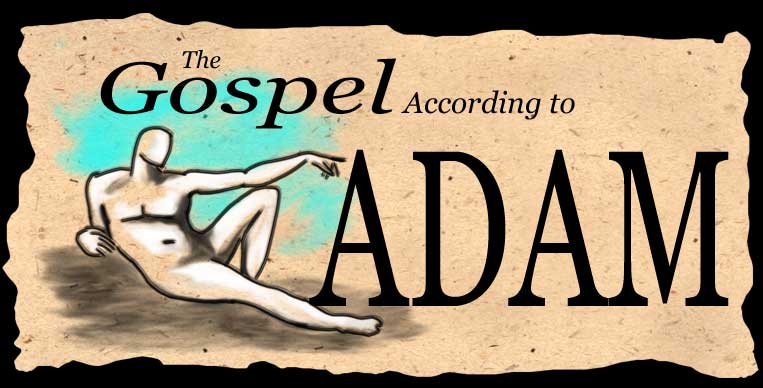
The Potter & His Creation by JQuisumbing
Imagine, if you will, that just before Adam died, he wrote his memoirs. You have to wonder, after living 930 years in this world, what message would he have for us? For my part, I would surmise that only one subject would weigh heaviest in his heart. You see, all the problems that we experience today… wars, conflicts, crimes, cruelty, hatred, pestilence, and yes, even natural disasters… can be traced back to Adam’s one fateful act of disobedience. Can you imagine the weight of the world-size guilt that he had to carry for almost an eon? I would probably bust. But he had almost a thousand years to think about it. How would he explain himself?
If I was in his shoes, my message to you would not be a drawn out pathetic excuse of what I did or didn’t do. If you recall in Genesis 3, Adam had already tried to use that same excuse on God Almighty when he pointed an accusing figure to the woman who God had made. Oops! I am getting ahead of myself. Let me take a step backward. With all the years that Adam had lived on this earth, I am most certain that he would be an excellent storyteller. And like every good storyteller, you start at the beginning. His beginning started with an incredible divine idea.
“Let us make man in Our image…” (Genesis 1:26a)
One of my great great grandsons, I don’t recall which one, for there were so many to count, asked “Grandfather, why does the Great Creator not care for us?”
“Why do you say that?” I asked. Some of them spouted what they heard from grownups about how hard life was and they were blaming… they peered up at the sky. “I see. If they knew Him like the way I knew Him in the Garden,” I told them.
“Oh, yes!” Another of my grandchild exclaimed excitedly. “We were told that you are the only one made from the dust of the earth. How was it done?”
“I really don’t know. After all,” I smiled mischievously. “I was just a lump of dirt.” The children laughed, but just then, when I mentioned ‘lump of dirt’, an idea came into my head. “I think I can answer both your questions. Come, follow me.”
I led them all into my workshop. I showed them my latest contraption fashioned by another of my offsprings, Tubal-Cain, who was a genius at iron works and in making machines like these. This machine allows me to produce many potteries in a lot shorter time than the old way. I told the children to gather around. I went up to it and sat on an attached bench. I slid my legs around and placed my feet to rest on a large granite wheel on the floor. The big wheel was attached to a smaller stone wheel about the same level of my stomach. Both wheels were perfectly balanced and aligned so it did not take much effort to spin it.
“Now children, pay close attention to my hands,” I instructed.
Then, I reached into a cubby hole and pulled out two handfuls of dried clay. Opening a large urn that was next to the contraption, I immersed that clay into water. When it was saturated enough, I pulled it out and slapped it down onto the center of the small wheel. I then started to continuously push the large wheel with my feet until it was spinning quite fast. At the same time, both my hands simultaneously and evenly pressed into that formless lump of clay until it turned into a squat cylinder shape. Not wanting it to dry out, I dipped my cupped hand into the water and sprinkled it on the clay. Using just my thumb, I pressed down in the center of the top and made a shallow indentation. It was when I pushed down about two inches, I shifted my fingers into position to push down deeper, at the same time gently compressing the sides, stretching and widening the walls; while my other hand applied opposite pressure guiding the outer wall up and preventing it from collapsing into itself. After twenty minutes, I slowed down the spinning and where once a shapeless blob of mud sat, now sits a tall urn with its beautiful shapely curves.
“Wala!” I said, as the children expressed with ‘Oohs’ and ‘Aahs’.
“Grandfather, was that really the way it happened?”
“Oh no no,” I said, chuckling. “My body… as are all yours, as well, are fearfully and wonderfully made. And great is He who sits in the Heavenly realm.”
“As I made the clay pot, what did you learn about the Lord Creator?” I asked them, but they all looked at me questioningly. “I see. What were you mostly focused on?” They all answered, “the clay… the pot.”
“Ah! You did not follow what I asked you to do. Your focus was on the object instead of the maker. You see, I wanted to illustrate something about the Great Maker through how my hands formed this pot. How would you describe my hands as I formed the clay?” Some of them described it as skillful, masterly and precise. “Is that all?” I asked.
“Love… the urn was formed by loving hands,” said one of them. I turned to look at the boy closely, sensing something about him. “Are you not the son of Methuselah? You are…aah…”
“I am Lamech, Great Grandfather.”
“Yes, you are. And that was the right description I was waiting for. One of you earlier asked whether the Lord Creator cared? As you saw how I lovingly formed this pot, know that the Creator loves me, you… all of those who were created in His image.”
“That love will ultimately be translated into an offspring that will come from…” I turned to Lamech, son of Methuselah, “…one of you.”
When I consider your heavens, the work of your fingers, the moon and the stars, which you have set in place, what is man that you are mindful of him, And a son of man that You are concerned about him? (Psalm 8:3,4)
Footnote:
Who was Lamech? In Genesis, there were 2 Lamechs mentioned in chapters 4 & 5. One was from the lineage of Cain; the other was through Seth. And if you follow Seth’s genealogy all the way to the New Testament, you will find JESUS CHRIST.
<NEXT>
 Johann Quisumbing